Most kanban boards fail for the same reason diets fail too many rules, not enough follow-through.
What Is a Kanban Board?
A kanban board is a visual system for tracking work as it moves through defined stages, typically To Do, In Progress, and Done. Originating from Toyota’s manufacturing floor in the 1940s and later adapted for knowledge work, kanban’s core principle is simple: make work visible so bottlenecks are obvious before they become emergencies. For a 5–15 person team, that visibility replaces something expensive status meetings, check-in emails, and the constant low-grade anxiety of not knowing where things stand.
Why Small Teams Need a Different Approach Than Large Ones
Enterprise teams use kanban boards with swimlanes, custom fields, multiple linked boards, and dedicated administrators. None of that is necessary or even helpful for a small team. A 5–15 person team doesn’t have the coordination overhead that justifies that complexity; it has the opposite problem, where added structure becomes friction that slows the team down rather than clarifying anything. The right kanban setup for a small team is the simplest one that still gives everyone an accurate picture of reality.
The Three Columns Most Small Teams Actually Need
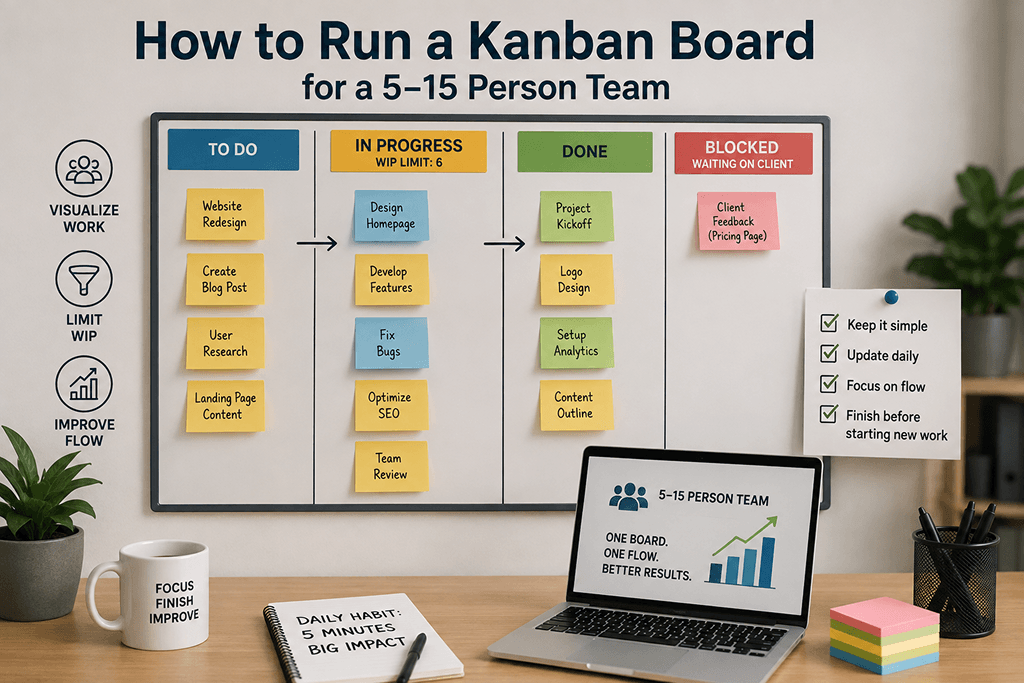
Start with exactly three columns:
- To Do — agreed, prioritized, and ready to start (not a dumping ground for every idea anyone has had)
- In Progress — someone is actively working on it right now, today
- Done — finished, with no follow-up work required
Add a fourth column usually Blocked or Waiting on Client only once you find yourself needing it in practice. Building it in from day one, before you know if you need it, is exactly the kind of premature complexity that causes boards to fall out of use.
Set a WIP Limit Before You Set Anything Else
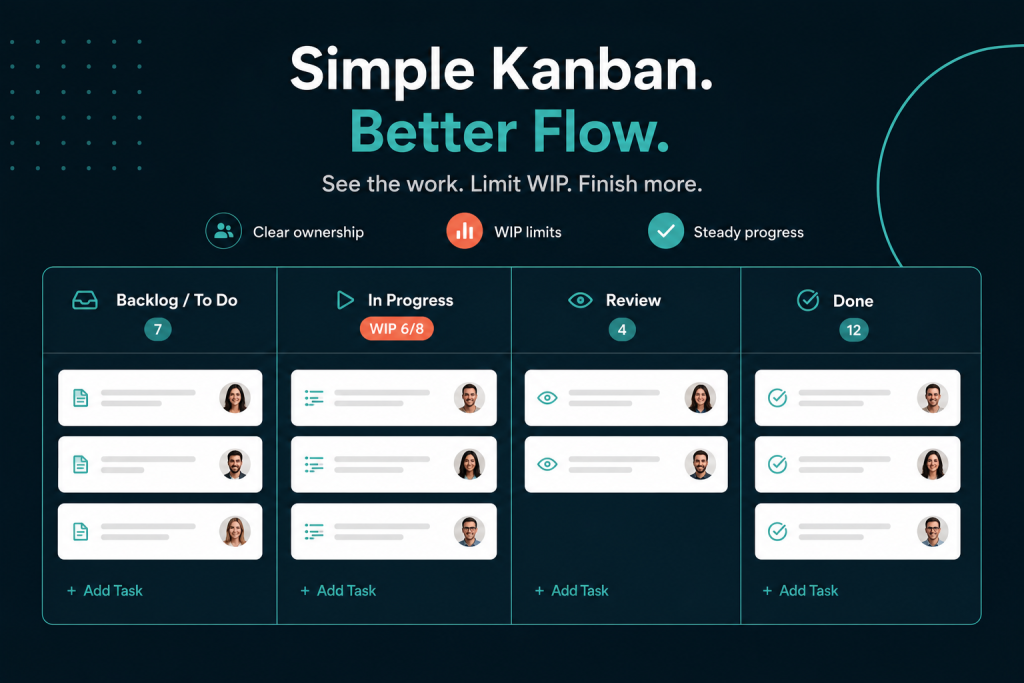
Work-in-progress (WIP) limits cap how many cards can occupy the “In Progress” column at once. For a team of eight people, capping that column at six to eight cards slightly fewer than headcount, not one-per-person forces people to finish work instead of starting five things badly. WIP limits are, by a wide margin, the single highest-leverage kanban rule a small team can adopt, because they directly address the most common failure mode: everything is “in progress” and nothing is actually moving.
Make It a 5-Minute Daily Habit, Not a Meeting
A kanban board only works if people look at it daily that’s the entire mechanism by which it replaces status meetings. The lightest sustainable version: everyone updates their own cards before a fixed time each morning, and the team lead does a five-minute visual scan, not a synchronous meeting, just a look. Cards that haven’t moved in three or more days are the only things worth raising out loud everything else is already visible and doesn’t need to be narrated.
Common Kanban Mistakes Small Teams Make
- Copying an enterprise template with too many columns and custom fields nobody actually fills in
- Skipping the WIP limit, which turns “In Progress” into a graveyard of half-finished work
- Treating the board as documentation that gets updated occasionally, instead of a living tool checked every day
- Assigning cards to more than one person, which quietly removes accountability from everyone
Key Takeaways
- Three columns and one WIP limit outperform a complex, feature-heavy board for teams of this size
- The board replaces status meetings only if it’s checked daily that’s non-negotiable
- Add complexity reactively, based on a real need you’ve hit, never proactively “just in case”
Frequently Asked Questions
What’s the ideal WIP limit for a small team’s kanban board?
A useful starting point is slightly below your team’s headcount for an 8-person team, a WIP limit of 6–8 cards in “In Progress” works well. Adjust down if cards are still sitting unfinished for multiple days.
Do I need special software to run a kanban board?
No a kanban board can be run on a whiteboard or sticky notes. Software becomes useful once you need remote visibility, deadlines attached to cards, or reporting for someone who isn’t in the room, which is common past 5 people.
How is kanban different from Scrum for a small team?
Scrum organizes work into fixed-length sprints with defined ceremonies (planning, review, retro). Kanban is continuous work flows through the board without being locked into a sprint cycle, which tends to suit small teams with frequently shifting priorities.
How often should columns be reviewed or changed?
Rarely. Revisit your column structure only when a real, recurring problem shows up for example, work consistently stalling for an unclear reason. Changing structure too often undermines the habit of checking the board daily.